The World’s Aquarium in the Face of the Climate Crisis—and How Young People Can Help Save It

Updated: Sep 21
This is the last post in a blog series exploring how Ecology Project International works with students to understand and address climate change across its different program sites. You can read the rest of the series here.
In one place, immense and striking biodiversity coexists with the aridity of a desert. The Gulf of California, also called “the Sea of Cortez”, is known as “the world’s aquarium,” a term coined by the famous oceanographer Jacques Cousteau. And for good reason: it is home to more than 900 species of fish and welcomes gray whales, whale sharks, green turtles, and sea lions, while also containing mangroves, seagrass beds, and coral reefs.
All of this is surrounded by a cactus-filled desert, one of the driest in all of Mexico. But this rich and seemingly contradictory ecosystem is extremely fragile, and the impacts of climate change are already being deeply felt. Although more than 40% of the state of Baja California Sur’s territory is protected, temperatures have risen systematically over the past 40 years.
In a desert region, this has a major impact on already scarce freshwater sources. Extreme droughts affect the ability of aquifers to recharge, and six of the region’s 39 aquifers are already considered overexploited. Rising sea levels also allow saltwater to seep into underground drinking water sources. And without water, there is no life. These impacts affect the nearly one million people who live in the state.
Climate change is also having a major impact on biodiversity. Coral bleaching, ocean acidification, and rising sea temperatures are already being recorded, causing many species to migrate out of the region in search of cooler waters. This also affects commercial fishing, one of the region’s main economic drivers.
Along with longer droughts, more intense hurricanes with changing trajectories have been affecting areas that were previously less vulnerable.
Faced with a reality that can feel overwhelming, we at EPI Mexico believe that young people,who will have to confront many of these challenges in the future,can and must be involved in creating solutions. This begins with education and awareness, followed by collective action.
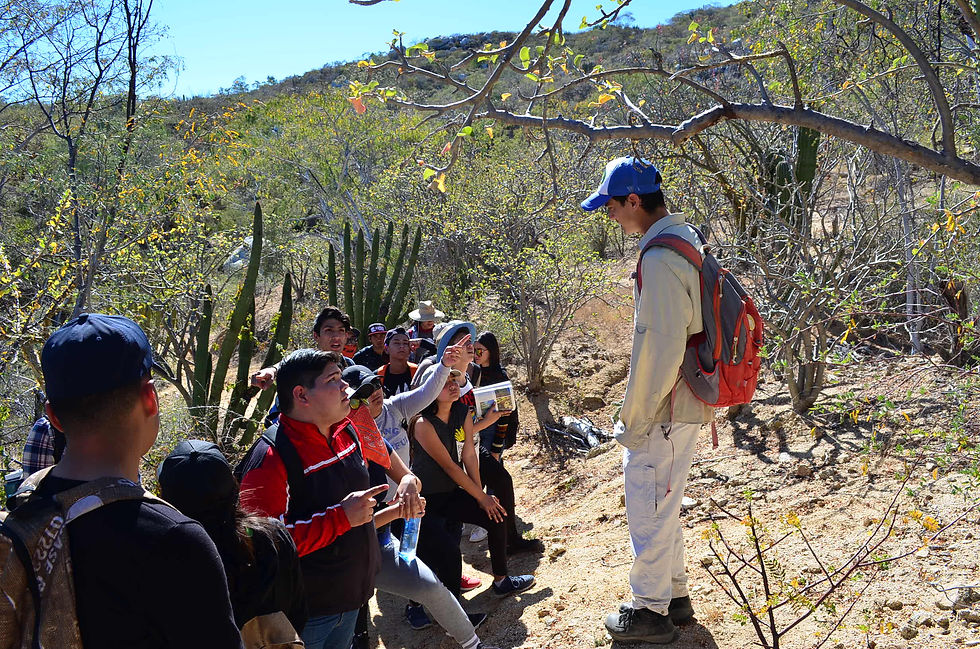
That is why our work focuses on two main areas: our Outdoor School, which includes courses and educational programs, and our Outreach and Alumni activities. But how does all of this connect to climate change? Here’s a closer look:
An Outdoor School
For nearly 21 years, EPI has been working in La Paz, Baja California Sur, providing environmental education to high school and university students. Our Outdoor School program works directly with course participants, both international and local.
As an international organization, EPI works in five countries and has a strong visiting student program. In La Paz, however, there is a particular emphasis on students from the state. Currently, visitors are offered one course focused on island ecology and marine science on Espíritu Santo Island, while local students can choose from a wider variety of experiences, ranging from multi-day courses to single-day programs.
During the one-day trips, students visit permaculture projects on ranches and sustainable aquaculture initiatives.
“We talk about ranch life, about how water scarcity is addressed to keep the ranch productive, the different species, the periods, the seasons, rainwater harvesting systems, aquifer recharge,” explains Fernando Noriega, EPI Mexico’s Outdoor School Program Supervisor.
Longer, multi-day courses explore topics such as sea turtle monitoring on a nesting beach, whale shark monitoring, the ecology of coastal ecosystems on the island, and desert and water. There is also a youth leadership formation process, which emphasizes leadership skills and collaborative work, more than on a specific issue or ecosystem.
While no course focuses 100% on climate change, it is always present as a cross-cutting theme.
“All the ecosystems where we work,the reef, the mangroves, the desert are ecosystems that are super vulnerable to climate change. So practically all the research that is done, all the monitoring, has to do with climate change.”
The course curriculum also includes activities and games that help students identify the impacts of climate change. One example is the “Plankton Race,” a rally-style activity designed to help students understand the life cycle of these organisms and the different threats they face in the ocean. At different stations, participants explore various causes of species mortality, both natural and human-caused, their implications, and ways to counter them.
“Our programming assumes a certain educational progression in which students begin at a level where they need to understand, but little by little, as they acquire knowledge and skills, they advance in their environmental literacy, until they reach a point where they can identify real problems,” Fernando explains.
All courses are designed to help students identify ecological challenges in their communities, gather scientific information, and propose solutions. In many cases, projects remain at the idea stage, but some have progressed to prototyping and even implementation. These projects are presented at the annual Mi Comunidad Sustentable Festival.
“Global warming is like an underlying theme, maybe not in everything, but it is definitely the most recurring issue that is addressed. Many of the projects focus on waste reduction, minimizing plastics. The central issue is clearly global warming; it is the major problem that everyone is addressing,” Fernando says.
Beyond the Courses
While courses are at the core of our work, it is important to go beyond them. That is why EPI México places a strong emphasis on working with alumni and building connections with communities and institutions.
EcoClub Californios Verdes is a group open to anyone who has participated in an EPI course. It is an autonomous organization supported by EPI, and its members do not just meet occasionally. They gather every week, participate in festivals, fairs, and conferences, and develop their own projects.
“In the programs we have already worked on through the EcoClub, the issue of climate change is integrated into the rest of what we do. It is not the main focus, but one of the many areas we work on—if the young people want to develop a project, if they want to get involved in a talk or take on topics related to how the climate crisis is having an impact locally,” explains María Agüirre, Alumni Program Coordinator.
EPI México and Californios Verdes also actively participate in spaces for dialogue with public institutions and other environmental and youth organizations.
“The strongest thing EPI México is working on right now in terms of climate change started a year ago; it is a project that excites us a lot. The UN has a convention, the United Nations Framework Convention on Climate Change, which takes a youth declaration to the climate COP that takes place every year. This is done through a specific working group for children and youth called YOUNGO, and YOUNGO coordinates spaces at the national level in different countries called LCOY, Local Conference of Youth”, explains María.
Because México is such a large country, before national youth gatherings take place, processes are organized in each of the country’s 32 states. These are known as Youth Climate Summits, or CCJs. This year, EPI once again supported youth groups in Baja California Sur in organizing the CCJ.
“EPI’s role in these summits is to facilitate the strengthening of young people’s soft skills. We run workshops, facilitate the working groups in which the positions for each of the different areas are developed, and help evaluate participants’ profiles using rubrics that assess each person’s capacities”, says María.
The idea behind the CCJs is for young people in each state to organize themselves and choose their own thematic priorities, since the context of the climate crisis is very different in coastal or desert regions than it is in inland or mountainous areas.
At this year’s Summit, held at the end of July, participants addressed four thematic areas: regeneration of marine and coastal ecosystems, a just energy transition, watersheds and climate change, and the Escazú Agreement (the right of access and defense of territory).
As a result of the collaborative work in these spaces, young people developed a State Position that promotes clear commitments toward a more sustainable and just future for Baja California Sur.
EPI is also integrating the CCJ process into its alumni work, creating a new pathway for students to get involved—not only through courses, but also through the EcoClub and other opportunities we facilitate.
“Last year, one of the girls who participated had been a Californio Verde, she was an EcoClub leader, and she was one of the people who went to represent at the national level and now she is part of an advisory council. It is striking to think that these young people, 15, 17 years old, are so aware of how their environment has changed and how the climate crisis is affecting it, and they are also starting to take action on projects they would like to carry out,” María explains.
Climate change is an enormous and often overwhelming challenge. But seeing young people become aware, reflect, and take collective action in search of solutions is inspiring. At EPI, we believe there is still much that can be done to confront the defining crisis of our era, working hand in hand with young people in México and around the world.
This is the final installment in a series of blogs exploring how climate change affects the different places where we work and the ways we are addressing these challenges through our work, as part of our mission to foster tomorrow’s environmental leaders. You can read the rest of the series here:
Sea Turtles in a Warming World: How EPI Teaches Climate Change in Costa Rica
Belize’s Coral Reefs on the Climate Frontlines: How EPI Engages Students in Real Solutions
Galápagos in the Face of Climate Change: An Urgent Lesson from a Natural Laboratory
Yellowstone at a Crossroads: Science and Resilience in the Face of Climate Change


